Dubai: the incredible story of the DIFC district
Introduction: How a desert became a global financial center
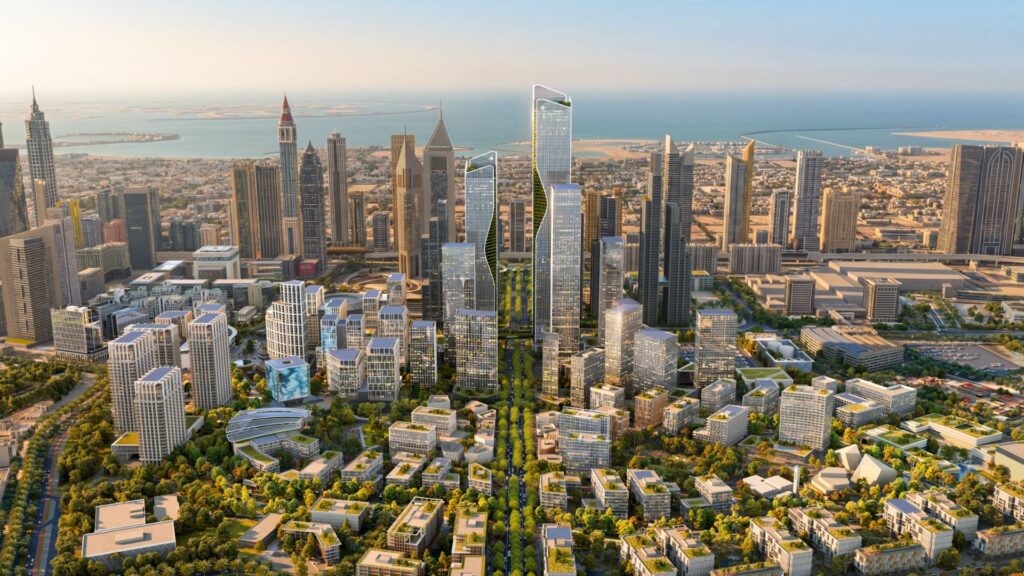
Today, DIFC is one of Dubai's most prestigious neighborhoods. Iconic towers, the Dubai Stock Exchange, headquarters of international financial institutions, gourmet restaurants, art galleries, ultra-premium residences—it has it all. Yet just twenty years ago, this area was nothing more than a vacant lot along Sheikh Zayed Road.
The history of the Dubai International Financial Center (DIFC) is the story of a bold political vision. The ambition was clear: to create a financial center in the Middle East capable of competing with London, New York, and Hong Kong.
The vision: positioning Dubai on the global financial map
In the early 2000s, Dubai was already experiencing strong growth in real estate and tourism. But the authorities understood that a model based solely on trade, transportation, and tourism was not enough to ensure lasting power.
Under the leadership of Mohammed bin Rashid Al Maktoum, the current Emir of Dubai, the goal became clear: to diversify the economy and attract international financial institutions.
The challenge is immense. At that time, the region did not have a true global financial hub with an internationally recognized legal framework.
2004: the official creation of the DIFC
In 2004, the DIFC was officially launched. But it is not just an office district. It is an independent jurisdiction, with its own regulatory framework and a legal system based on English law.
This decision changes everything. Major banks and international funds need legal certainty and global standards. The DIFC offers them exactly that, right in the heart of the Gulf.
The financial center has its own regulator, its own courts, and an attractive tax environment. The strategy is clear: to reassure international capital.
A rapid and ambitious construction project
Real estate development followed immediately. The first towers rose along Sheikh Zayed Road. The famous arch-shaped Gate Building became the architectural icon of the district.
The architecture symbolizes power and stability. Public spaces are designed to reflect an international image. The neighborhood is not conceived as a simple business district, but as a premium environment.
Within a few years, hundreds of financial institutions set up shop. Investment banks, international law firms, asset management companies, and insurers established their regional headquarters in the DIFC.
Growth driven by stability
The 2008 financial crisis slowed down Dubai's real estate market. But the DIFC is holding up better than other sectors. Why? Because its model is based on financial services and not solely on real estate speculation.
Gradually, the neighborhood is consolidating. Infrastructure is improving. The subway is improving accessibility. Regulatory standards are gaining international credibility.
The DIFC is becoming a strategic gateway to the markets of the Middle East, Africa, and South Asia.
From financial district to living district
Over the years, the DIFC has evolved. It is no longer just a business center. High-end residences are appearing. Michelin-starred restaurants are opening. Art galleries are opening their doors.
The neighborhood attracts a demanding international clientele. Senior executives want to live close to their offices. Premium residential real estate is developing naturally.
The DIFC is becoming a complete ecosystem: work, housing, gastronomy, art, and networking.
The DIFC effect on Dubai real estate
The existence of the DIFC has profoundly changed Dubai's real estate market. Demand for high-end housing near the district has skyrocketed. Surrounding areas such as Downtown Dubai and Business Bay have benefited from this knock-on effect.
A stable financial district generates skilled jobs. Skilled jobs generate premium residential demand. It's a virtuous circle.
Today, the DIFC is one of the structural drivers of high-end real estate demand in Dubai.
Continued expansion
The DIFC did not stop at its creation. It continues to expand, attracting fintechs, alternative investment funds, and international family offices.
The strategy remains consistent: positioning Dubai as a global financial hub connecting the West and Asia.
The figures speak for themselves. The number of registered companies continues to rise. Assets under management are growing. The district remains highly attractive despite global competition.
Why this story matters to an investor
Understanding the history of the DIFC helps to understand Dubai's overall strategy. This district did not come about by chance. It is the result of an ambitious vision, executed and consolidated over two decades.
A financial district cannot be created in a year. It requires political stability, a solid regulatory framework, and international credibility. The DIFC has ticked all these boxes.
For a real estate investor, this means one essential thing: demand for the DIFC is based on real economic fundamentals.
Conclusion: the symbol of controlled ambition
The DIFC is one of the most striking examples of Dubai's ability to turn a vision into reality. In twenty years, a strategic piece of land has become a globally recognized financial center.
The story of the DIFC is not just architectural. It is strategic. It demonstrates Dubai's capacity for execution, economic consistency, and clarity of direction.
And it is precisely this type of story that explains why the city continues to attract investors, entrepreneurs, and capital from around the world.
Guillaume Giroux, Dubai Immo founder and real estate expert, Dubai, UAE
As founder of the Dubai Immo Group and a real estate investor, I bring you daily updates on the Dubai market. My aim is to provide you with all the keys you need to invest wisely and securely, by sharing my in-depth analysis and strategic advice.