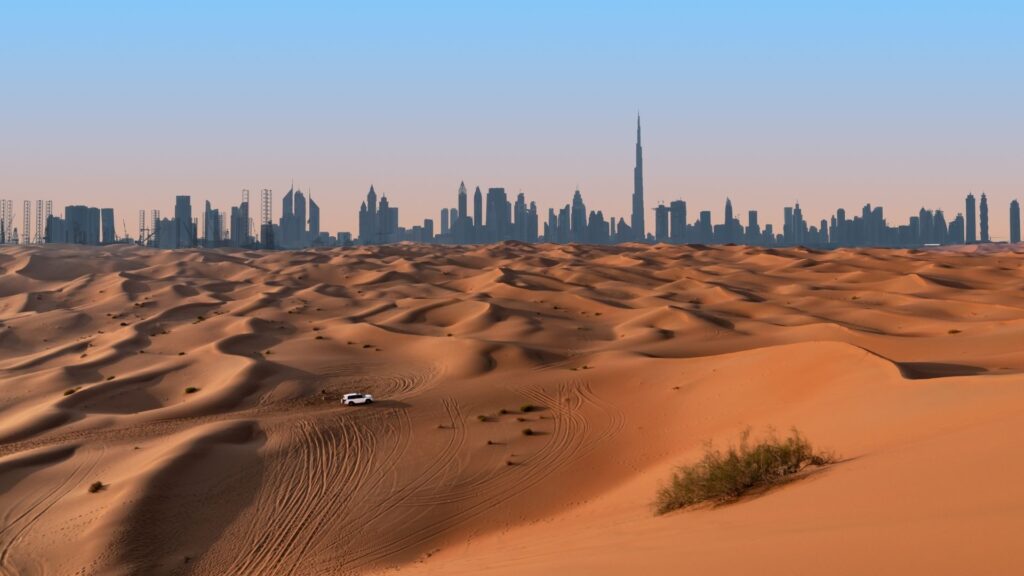
When discussing long-term investment in Dubai, the issue of climate often comes up. Temperatures are already high. Global warming is a worldwide reality. So should we fear a deterioration in living conditions in the coming decades? The answer deserves rational analysis. And it is often more nuanced than we might imagine from Europe.
Dubai was designed for the heat
Unlike European cities, Dubai was never designed for a temperate climate. It was conceived from the outset to function in extreme conditions. Centralized air conditioning, insulated buildings, adapted infrastructure, covered parking lots, connected shopping malls, indoor walkways: local urban planning incorporates heat as a structural factor.
In Europe, heat waves paralyze transportation, close schools, and put hospitals under strain. In Dubai, heat has always been part of everyday life. Systems are designed accordingly.
Oversized infrastructure
Electricity grids are designed to support massive consumption linked to air conditioning. New buildings comply with strict energy standards. New neighborhoods incorporate more shaded areas, green spaces, and reflective materials to limit the heat island effect.
Road infrastructure, airports, and public transportation already operate in very high temperatures. This reduces the risk of sudden disruption in the face of a gradual increase in average temperatures.
Ability to adapt quickly
One of Dubai's major strengths is its speed of execution. When a need arises, the response is swift. The massive development of solar energy is one example. Investments in water management, desalination, and energy optimization demonstrate a clear desire to anticipate future needs.
Urban planning is evolving. New projects place greater emphasis on sustainability, energy efficiency, and shaded public spaces. Cities are not passively enduring climate change. They are adapting their models.
Comparison with Europe: an often overlooked reality
In Europe, most older homes are not equipped to cope with prolonged summers with temperatures reaching 40 degrees Celsius. Historic city centers are poorly ventilated. Rail transport suffers in the heat. Electrical grids are not always designed to handle massive air conditioning use.
In Dubai, air conditioning has been standard for decades. The infrastructure is modern. The buildings are new. Adapting to the heat is not an adjustment, it is the norm.
This does not mean that there are no challenges. But the technical foundation is already in place.
The economic factor
Dubai has significant financial resources to invest in climate innovation. Solar energy, cooling technologies, energy efficiency, and smart resource management are strategic areas for the emirate.
A rich, young, and growing city has greater capacity to adapt than an old, indebted, and stagnant city. Climate change is a global issue, but the capacity to respond varies greatly from one region to another.
Quality of life and social adaptation
Life in Dubai is already organized around the seasons. Outdoor activities are concentrated in the more temperate months. Indoor spaces are optimized. Beaches, swimming pools, and air-conditioned spaces structure daily life.
Over time, construction technologies will continue to evolve. New projects incorporate more vegetation, shaded areas, and smart urban planning. Improvement is ongoing.
People who choose Dubai know where they are settling. There are no surprises when it comes to the climate. This creates a kind of conscious commitment.
What about long-term real estate?
For investors, the key issue is resilience. A city that is able to anticipate, finance, and implement structural adaptations is better positioned to deal with climate change than a city that simply reacts to it.
Dubai has already proven its ability to transform its environment in just a few years. Infrastructure, construction standards, and energy investments point to a clear direction.
Global warming is a global challenge. But not all cities are starting from the same point. Dubai is already equipped for the heat. It always has been.
Conclusion: a risk to be put into perspective
Climate change is a global reality. Ignoring it would be a mistake. But believing that Dubai is more vulnerable than major European cities is often a biased perception.
The city is designed for heat, has significant financial resources, and is constantly adapting its urban planning. For the coming decades, the question is not whether Dubai can withstand high temperatures. It already does. The real question is its ability to evolve. And so far, its track record of adaptation is solid.
For a long-term investor, this matters.